Don’t step on me, I’m important!
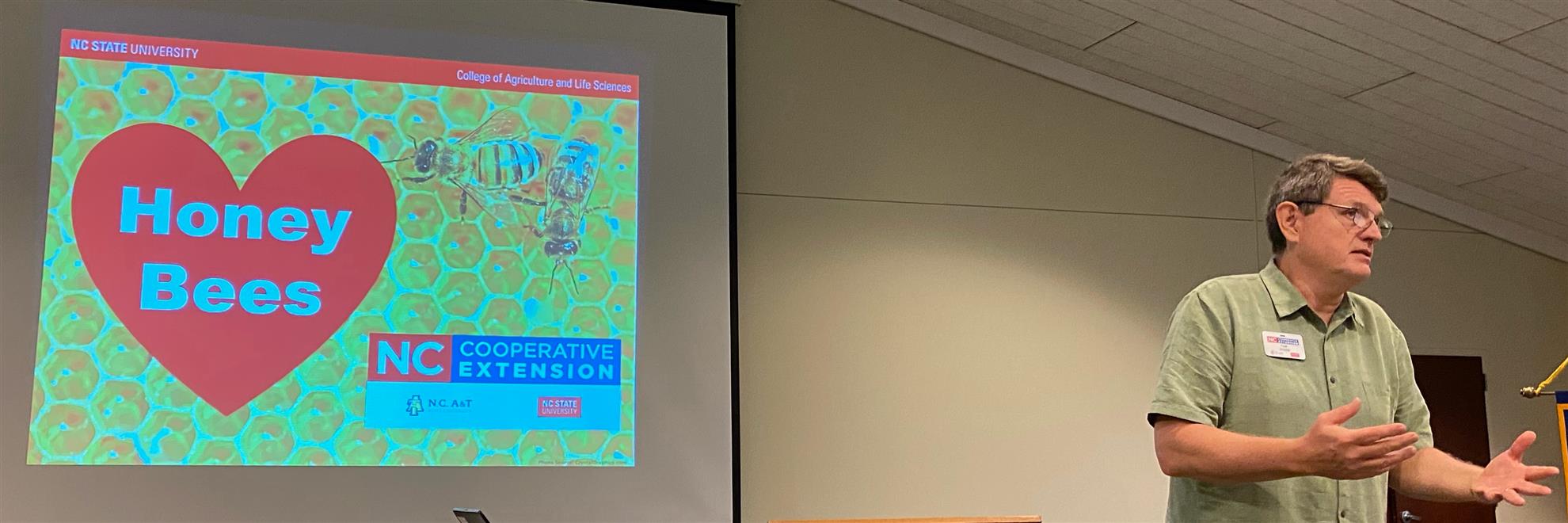
There was a BUZZ in the air last Wednesday, March 22, 2022 at the Denver Lake Norman Rotary Meeting. The Club welcomed as its guest speaker Tom Dyson, Lincoln County Director for the North Carolina Cooperative Extension Service. Tom began his role in Lincoln County in August 2014. He received his Bachelor of Science and Master’s degrees in horticulture from Virginia Tech and his Master’s degree in Intercultural Studies from Southeastern Baptist Theological Seminary at Wake Forest. He spent time as an agriculture consultant and educator with the International Service Corps in Merida, Venezuela. Tom also founded, coordinated, and taught at ENTRA Missions School in Oaxaca, Mexico. While in Mexico, he served as the interim director of the Baptist Theological Seminary, as well as acting as a seminary professor.
In his talk, Tom spoke about honey bees. The honey bee is a pollinator. Pollination is the process by which plants can reproduce and create seeds and honey bees are responsible for millions of dollars in crop yield every year. If it were not for the pollination from honey bees there would be no tree fruits, garden vegetables, bananas, berries, and many other foods that we eat.
Honey bees live in colonies called hives. A hive may contain anywhere from 8,000 to over 50,000 bees. There is one queen bee, thousands of female worker bees and hundreds of male drone bees in a hive. Farmers are known to keep a number of beehives around their farms. There are a number of beekeepers who maintain the beehives as a hobby and to collect the honey from the hives. Tom was able to give us a live demonstration on how a honey bee gives directions to its hive when it finds a big collection area. The bees use a series of flying around in a pattern and the speed of the flapping their wings to give directions on how to get the source of nectar. The bees then fly to the source of the nectar and remove it, using their proboscis (an elongated mouth part) and store it into their honey stomach (bees have two stomachs). While they are removing the nectar, they are also pollinating the plant. When they move onto another plant, once again pollination take place. This allows the plants to continue to grow. When the honey bee has filled its nectar sac, it returns to the hive. At the hive, the drone bees transfer their nectar to a worker bee. The worker bee adds enzymes, until it is suitable for storing in a cell of the honeycomb. At this point there is “HONEY”
The club thanks Tom for all of this wonderful information about common honey bees. Denver Lake/Norman Rotary looks forward to hearing from Tom and his department again in the future. More information can be found at this website: www.lincoln.ces.ncsu.edu





.png)